

tobias m. schiel
It has been said that photographing things means distancing oneself. Among others, Susan Sontag seems to establish a close connection between photography and estrangement. Consider western travellers: They put the camera between themselves and the places they visit, so they would not be exposed to new impressions directly. And it gives them something to do. Instead of opening up to new experiences they fall back on a well-known routine. Or so Sontag says (On Photography).
 Travelling … “If only I could travel to exciting places, I could make exciting pictures,” many amateur photographers complain. I do not buy that.
Quite on the contrary, I love visiting and revisiting certain spots in and around my home town (as well as going on the same journey more than once) because I feel I can get more and more familiar with the places’ potential for pictures.
Getting to know certain places like that may well be what Robert Capa had in mind when he declared: “If your pictures aren’t good enough, you’re not close enough.” Getting closer lets you discover nuances the hurrying eye would probably miss. In a way, it means finding the new, the exciting in your immediate environment. When I photograph, I literally step towards the object. Rather than replace that 50 mm lens with a 135, I would walk. And I may even make several pictures while I approach the object. More often than not, this very spatial movement gives me a feeling of closeness.
Thus, even if I do not approach an object in order to gain ‘hard’, intellectual insight (as I wrote in Aesthetic Investigation), I feel quite the opposite of what Susan Sontag describes.
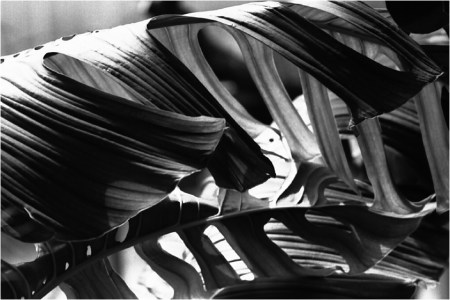


 As I consider the way I photograph (or why I photograph, for that matter) I tend to think that photography is an aesthetic investigation into the nature of things. And a fine one, too.
‘Aesthetic’ implies that I do not necessarily have to know what plant exactly I am photographing. Rather, my considerations focus on the picture itself. I can see what the plant looks like, but I want to learn whatever I can about the plant-picture.
Somebody once said that photography must inevitably represent something and that a photograph will always be a footprint of the real. Apparently, a photograph cannot transcend the real. A photo will always be a picture of something. This opinion seems to be fuelled by spectators who feel uneasy facing a photo they cannot decode: “What does this picture show? What’s this a photo of?” Because they know that every photograph must be a picture of something.
But is it really impossible for a photograph to go beyond depiction? I do not think so. Classic black-and-white photography is a form of abstraction, some kind of departure from reality.
In order to further transcend the real object, I asked myself how abstract a photo could be. Now I am asking myself how abstract it should be.
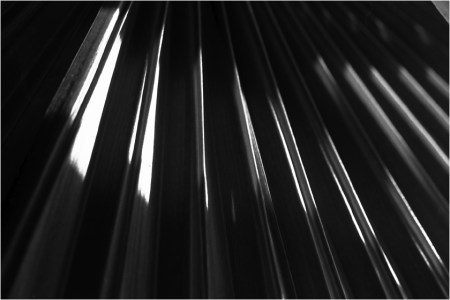
Initially, Eduardo Chillida’s pictures inspired me to make photographs which are abstract beyond classic black and white, eliminating the greys so that the only pictorial elements would be either deep black or white. The resulting forms, structures and pictures were supposed to be of utter simplicity. Thus, the following picture may acutally resemble a rather drippy abstract painting.

But I came to realize that playing with ‘pure form’ had its limits, that the contents of those pictures tended to be rather superficial. I felt that total abstraction was not possible – and not even desirable. Still, I wanted to find out more about the relationship between real space and the picture plane.
A survey of reality seemed a worthy goal. But I wanted this survey to materialize in pictures that not only refer to reality but also to themselves.
This is one of the results:
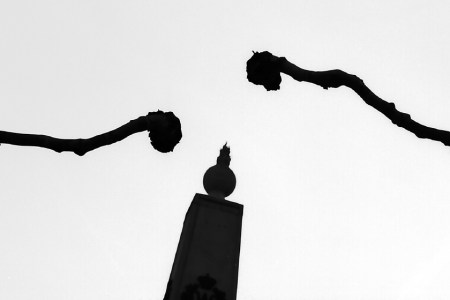
And, after a further step towards depicting things (and after a couple of failures) I came up with this one:
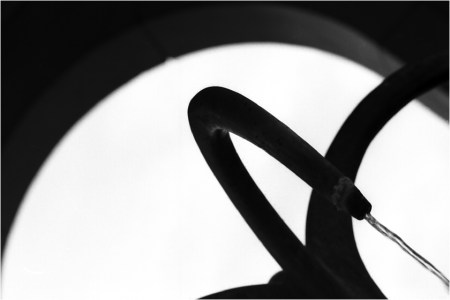
Finally, I gave up the extreme contrasts:
 All these may be examples of a kind of photography that gave up narrative. They may fail to fulfil most spectators’ expectations. And I do not even know they really ‘work’. But one thing is for sure: These thoughts and photographic attempts have taught me a lot.
 empire of lights