Category: Composition
Making Pictures


This was not originally written to appear in this blog. However, I realize that my thoughts about photography are taking a turn that would appear less intelligible without this short description. I thus translated it to appear here. The original text is also available.
Speaking of ‘an eye for photography’ I understand that the photographer sees the world as a reservoir of potential pictures and that he will do everything he can in order to make the best of this potential.
Maybe he will find a picture remembering Andreas Feininger once said that everything worth being photographed is worth being photographed a couple of times. Such repeated scrutiny of a subject may take place at very different times of the day, or the year. It so allows for numerous variations of a theme.
Once you start producing variations your perspective may widen, from a particular lake to water in general, from this one flower to constellations of flowers and leaves (and finally to plants ‘as such’).
Meanwhile, it is interesting to observe how the picture changes when you omit colour. This omission does not produce a lack, but rather emphasizes the structures of the subject which will now appear more clearly. Black-and-white also seems to imply a relation to the graphic arts (such as etchings or woodcuts).
You may try to push abstraction still further. In doing so, you might not aim at the kind of clarity you seek when involved with documentation, being satisfied only when you present yet more aspects and more details – but rather at a greater clarity that allows the picture to stand for itself, independently of whatever it might depict.
No Void
In the frame, there is always something, anything; it is all over the picture.

Thus, whatever seems to be all black or all white is not ever nothing. There was (is?) a referent, a piece of reality this part of the picture refers to.
In one of the most brilliant books on photography (Camera Lucida. Reflections on Photography), Roland Barthes understood that this is a crucial aspect when it comes to the nature of photographs.
I


Aesthetic Investigation
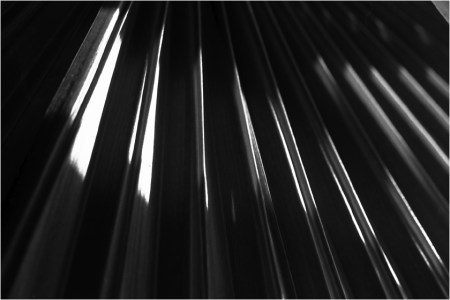 As I consider the way I photograph (or why I photograph, for that matter) I tend to think that photography is an aesthetic investigation into the nature of things. And a fine one, too.
‘Aesthetic’ implies that I do not necessarily have to know what plant exactly I am photographing. Rather, my considerations focus on the picture itself. I can see what the plant looks like, but I want to learn whatever I can about the plant-picture.
Abstract Photography?
Somebody once said that photography must inevitably represent something and that a photograph will always be a footprint of the real. Apparently, a photograph cannot transcend the real. A photo will always be a picture of something. This opinion seems to be fuelled by spectators who feel uneasy facing a photo they cannot decode: “What does this picture show? What’s this a photo of?” Because they know that every photograph must be a picture of something.
But is it really impossible for a photograph to go beyond depiction? I do not think so. Classic black-and-white photography is a form of abstraction, some kind of departure from reality.
In order to further transcend the real object, I asked myself how abstract a photo could be. Now I am asking myself how abstract it should be.
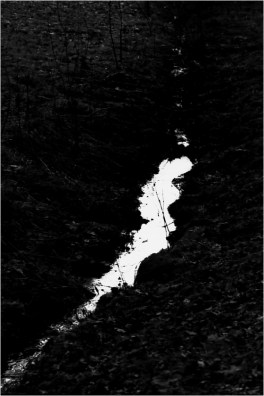
Initially, Eduardo Chillida’s pictures inspired me to make photographs which are abstract beyond classic black and white, eliminating the greys so that the only pictorial elements would be either deep black or white. The resulting forms, structures and pictures were supposed to be of utter simplicity. Thus, the following picture may acutally resemble a rather drippy abstract painting.

But I came to realize that playing with ‘pure form’ had its limits, that the contents of those pictures tended to be rather superficial. I felt that total abstraction was not possible – and not even desirable. Still, I wanted to find out more about the relationship between real space and the picture plane.
A survey of reality seemed a worthy goal. But I wanted this survey to materialize in pictures that not only refer to reality but also to themselves.
This is one of the results:
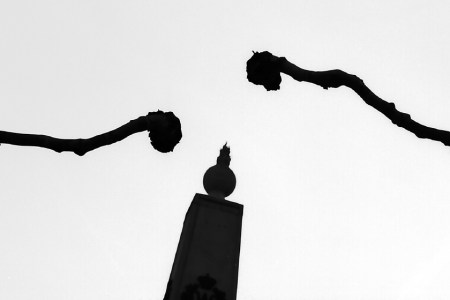
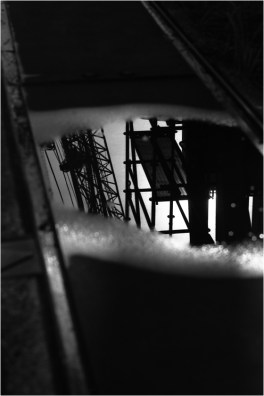
And, after a further step towards depicting things (and after a couple of failures) I came up with this one:
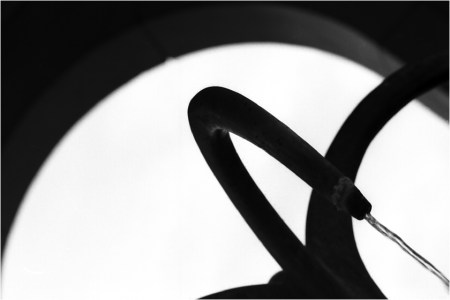
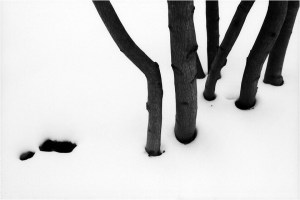
Finally, I gave up the extreme contrasts:
 All these may be examples of a kind of photography that gave up narrative. They may fail to fulfil most spectators’ expectations. And I do not even know they really ‘work’. But one thing is for sure: These thoughts and photographic attempts have taught me a lot.
 empire of lights