

Category: Nature
Ground Beneath Our Feet

Holzwege


Because of its connotations, Holzwege does not translate well. The word literally denotes forest paths or tracks (Wege) that only serve for transporting wood (Holz) from where it was felled and do not connect two places. Since these paths tend to end in the middle of nowhere, hikers who take these paths are likely to get lost. Hence “auf dem Holzweg sein” (being on the wood path) means being errant, lost, wrong.
I found these beech logs rotting in a forest. Decay has marked them in a way that evokes landscapes seen from above, or entirely insignificant maps…
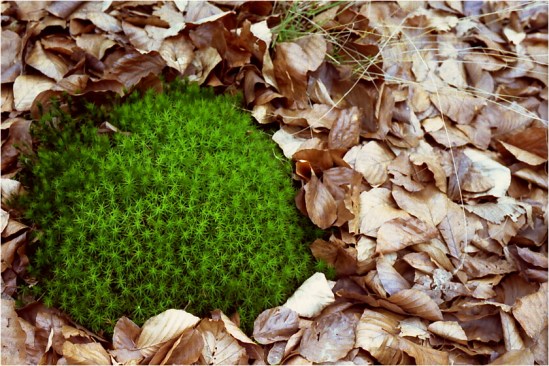
Winter Leaves II

Winter Leaves

Speed
Daily photos, 365 Photos a year… I can see the appeal of this.* But as for now, I do not travel that fast. Depending on weather, opportunities and interests (or motivation), it can take me two or three weeks to fill a 36-exposure roll of film. Afterwards, I have to allow a couple of days for processing. After receiving the pictures from the lab, I look over the contacts, trying to decide which picture is worth prinitng and what should be scanned and go online. Once I am done with this, I know my pictures quite intimately.

That’s the when I usually get excited about how well I succeeded in making this or that picture. I might hurry to get these exposures scanned and present them to you … or let them lie around untouched for yet another while. Waiting a couple of weeks entails that if I still like a picture after the first rush of euphoria is over – then this picture most likely meets my idea of a good one.
Why do I write this? Speedy publication can be lots of fun. But slowing down can be just as fine: If you are not sure what to think of your picture today, just wait. Time will help you take a step back, consider the picture in a different context and figure out what it means to you.
* There are some great sites for viewing daily pictures: The Window Project 2010 is one of them, and I would also like to mention the daily pictures displayed by Lynn Wiles. And whoever enjoys daily assignments will find them here.
Pocket Landscapes: Shore

Wet Feet


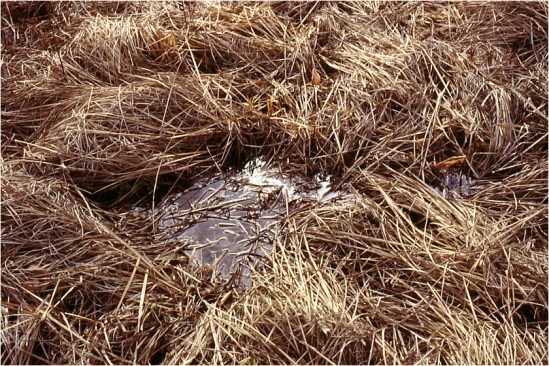
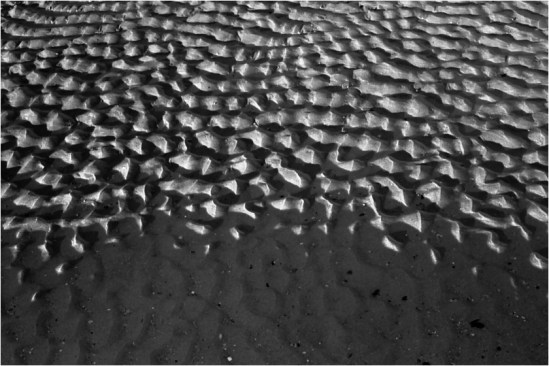
Winter weather comes and goes, and when it goes, it leaves us with the river Rhein flooding the feet of the Rheingau vines (top). While the snow melts off, smaller ponds in the woods stay frozen for a while (bottom).
Making Pictures


This was not originally written to appear in this blog. However, I realize that my thoughts about photography are taking a turn that would appear less intelligible without this short description. I thus translated it to appear here. The original text is also available.
Speaking of ‘an eye for photography’ I understand that the photographer sees the world as a reservoir of potential pictures and that he will do everything he can in order to make the best of this potential.
Maybe he will find a picture remembering Andreas Feininger once said that everything worth being photographed is worth being photographed a couple of times. Such repeated scrutiny of a subject may take place at very different times of the day, or the year. It so allows for numerous variations of a theme.
Once you start producing variations your perspective may widen, from a particular lake to water in general, from this one flower to constellations of flowers and leaves (and finally to plants ‘as such’).
Meanwhile, it is interesting to observe how the picture changes when you omit colour. This omission does not produce a lack, but rather emphasizes the structures of the subject which will now appear more clearly. Black-and-white also seems to imply a relation to the graphic arts (such as etchings or woodcuts).
You may try to push abstraction still further. In doing so, you might not aim at the kind of clarity you seek when involved with documentation, being satisfied only when you present yet more aspects and more details – but rather at a greater clarity that allows the picture to stand for itself, independently of whatever it might depict.
No Void
In the frame, there is always something, anything; it is all over the picture.

Thus, whatever seems to be all black or all white is not ever nothing. There was (is?) a referent, a piece of reality this part of the picture refers to.
In one of the most brilliant books on photography (Camera Lucida. Reflections on Photography), Roland Barthes understood that this is a crucial aspect when it comes to the nature of photographs.
Pocket Landscapes

Distance? What Distance?
It has been said that photographing things means distancing oneself. Among others, Susan Sontag seems to establish a close connection between photography and estrangement. Consider western travellers: They put the camera between themselves and the places they visit, so they would not be exposed to new impressions directly. And it gives them something to do. Instead of opening up to new experiences they fall back on a well-known routine. Or so Sontag says (On Photography).
 Travelling … “If only I could travel to exciting places, I could make exciting pictures,” many amateur photographers complain. I do not buy that.
Quite on the contrary, I love visiting and revisiting certain spots in and around my home town (as well as going on the same journey more than once) because I feel I can get more and more familiar with the places’ potential for pictures.
Getting to know certain places like that may well be what Robert Capa had in mind when he declared: “If your pictures aren’t good enough, you’re not close enough.” Getting closer lets you discover nuances the hurrying eye would probably miss. In a way, it means finding the new, the exciting in your immediate environment. When I photograph, I literally step towards the object. Rather than replace that 50 mm lens with a 135, I would walk. And I may even make several pictures while I approach the object. More often than not, this very spatial movement gives me a feeling of closeness.
Thus, even if I do not approach an object in order to gain ‘hard’, intellectual insight (as I wrote in Aesthetic Investigation), I feel quite the opposite of what Susan Sontag describes.
II

 empire of lights