
Author: Tobias M. Schiel
Abstract arts lover, Jazz enthusiast, mystery buff, compulsive reader - and how do I get it all into pictures? Photography has been a good way over the last couple of years.1. .
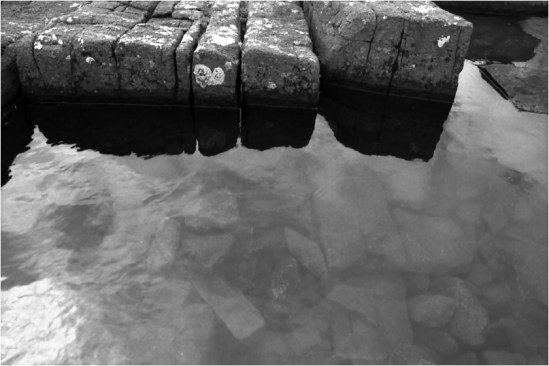
Neist Point Rocks and Pools (Isle of Skye)


Neist Point (Isle of Skye)

“My father was not an ‘inspector’ of lighthouses; he, two of my uncles, my grandfather, and my great grandfather in succession, have been engineers to the Scottish Lighthouse service, all the sea lights in Scotland are signed with our name; and my father’s services to lighthouse optics have been distinguished indeed. I might write books till 1900 and not serve humanity so well,” wrote Robert Louis Stevenson to his American publishers (quoted from Bella Bathurst, The Lighthouse Stevensons. London: Harper, 2005). Neist Point Lighthouse was designed by Louis’ cousin, David A. Stevenson.

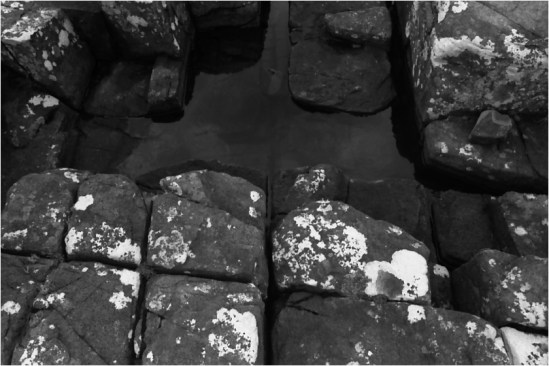
The Braes (Isle of Skye)
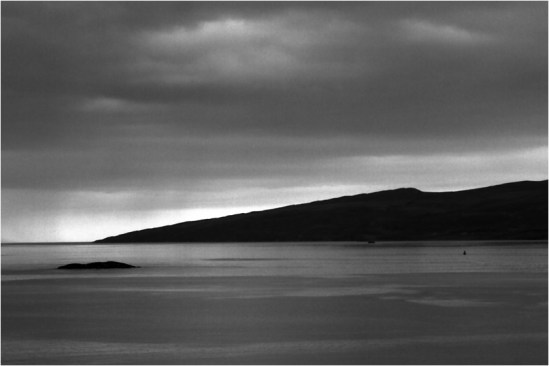

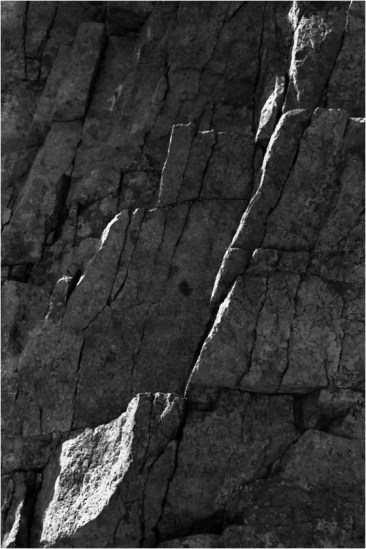

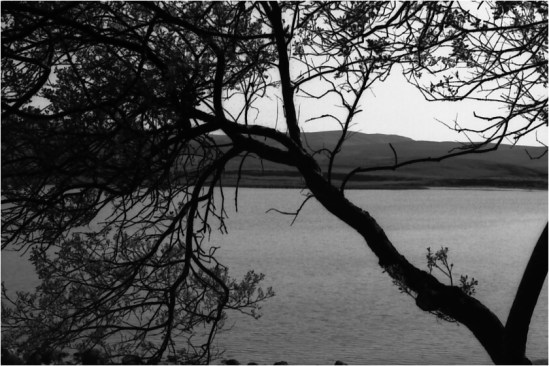 One of the many things I like about Scotland is the fact that even the remotest place has its own name. So, here goes: Sound of Raasay (1), Loch an Amadain (2), An Àird (3-5). Places can be found with the help of streetmap.co.uk, and Ordnance Survey helps those who care to make sense of the place names.
Ardvergnish, near Pennyghael (Isle of Mull)
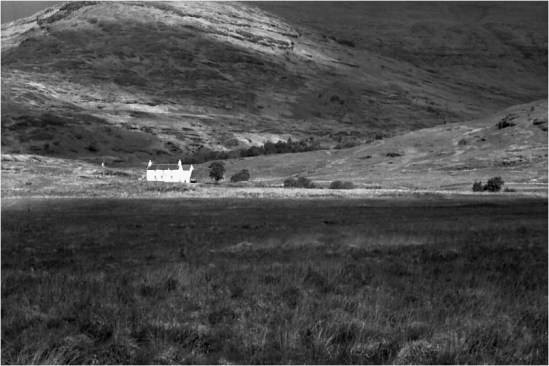
Hills and glens, rivers and lochs: Whenever I heard these words, a distinctive picture would form in my head and I knew that I had to travel Scotland one day. When this dream finally began to come true, we were quite sure about our destination: the Inner Hebrides. But I was not so sure what kind of pictures I would bring home. Would I seek confirmation of what I thought I already knew about Scotland – its nature, its climate, its topography, and maybe its picturesque-ness? Or would I rather follow up on recent thoughts about landscapes and maps, trying to see the abstract potential, as I would at home?
As much as we might think that abstract pictures could be made everywhere, they would not exist without a very specific ‘there’ (with a bow to Gertrude Stein, you may say that in a photo, there is a there there). They inevitably denote a location, probably transforming space into place … I do wonder if a photograph adds some kind of human scale to any given, nondescript space. By turning natural space into pictorial space, don’t we add some sort of meaning it would not have per se?
In the end, I found myself combining two angles: I took photos that would serve narrative ends and establish an account of our trip, and I made pictures in which I find a more or less abstract quality.
My introduction to the Inner Hebrides is a photo that represents what I came to see as a characteristic landscape: We found these white builings scattered through the Highlands and islands, a particular type of house that has its chimneys built into both gable ends.
Walking in Wiesbaden


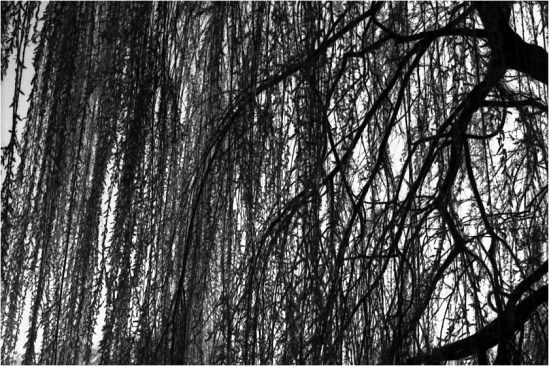
Willow Variations

Ground Beneath Our Feet

Stand There!
Photographs serve the illusion of realism, of showing the Eiffel Tower or the bombing of a Vietnamese village as it really was. Perspective strongly supports this illusion. It denotes three-dimensional space on the basis of construction rules that have been derived from optics. A camera basically follows the same optical laws we find at work in the Renaissance theory and practice of perspective. It is a machine for making central perspectives, very much like the devices contrived by Dürer and others to facilitate the drawing of perspectives.
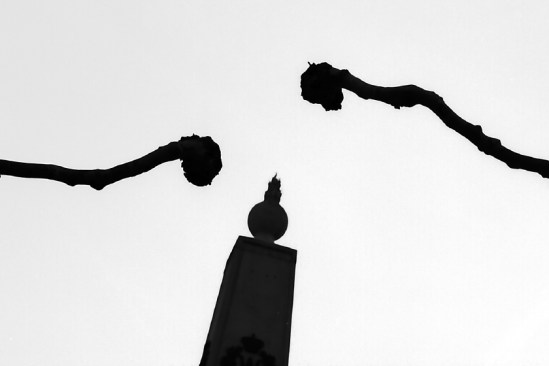
Perspective does not only denote space. It also positions the spectator: Central perspective works best if you stand right in front of the picture’s vantage point. You are thus made part of the geometrical arrangement; your (ideal) position, your eye is inscribed into the picture. For the image to captivate you and work its illusion, you have to cooperate, positioning yourself accordingly. Illusion comes at the price of a loss of freedom for the spectator.
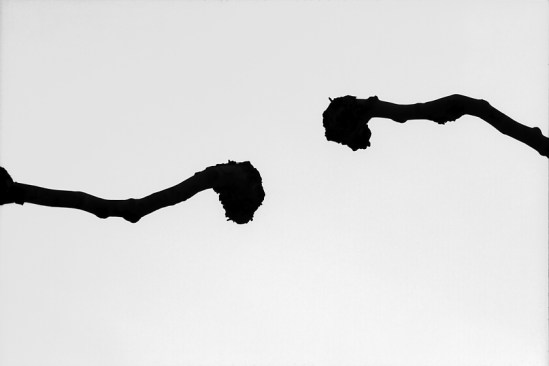
Would absence of perspective, emphasizing the picture‘s flatness, then mean that spectators regain a certain amount of freedom, being allowed to stand wherever they like, without missing anything?
If this were the case, speaking of Informel paintings as ‘democratic’ may not only cover the picture elements (which are all equal) but also the ‘positioning’ of spectators. Confronted with a painting by, say, K. H. Sonderborg, spectators can position themselves freely, they can pick any spot in front of the picture they like. There is a certain openness to this, some kind of laissez-faire a Renaissance painting following the rules of central perspective might lack.
.
Sources
Hans Belting, Florenz und Bagdad. Eine westöstliche Geschichte des Blicks. München: Beck, 2008.
Willi Kemp, “Das deutsche Informel”, Le grand geste! Informel und Abstrakter Expressionismus 1946 – 1964. Hg. v. museum kunst palast. Köln: DuMont, 2010.
Looking at the Window
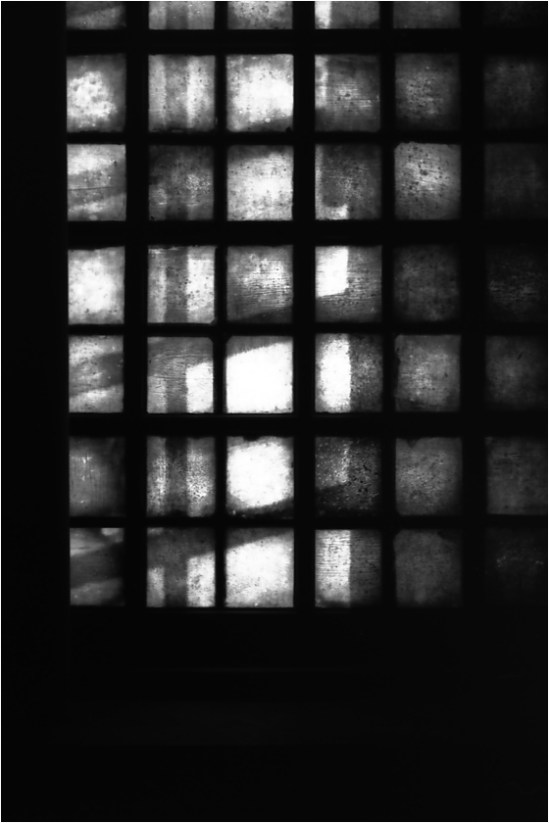
Putting Things Into Perspective
Until I wrote the lines about landscapes and maps, I never really realized the impact of perspective. A camera was a great machine for making perspectives; some perspectives were not what you wanted, especially when depicting architecture; you could deal with this issue by using the right lenses. That was all I knew and ever thought about.
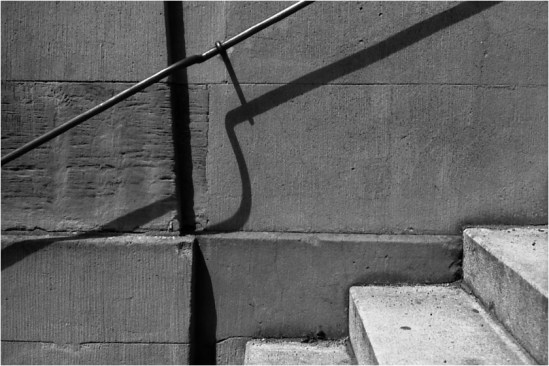 I remember using perspective quite deliberately in several pictures though (consider the steps above).
Still, I was not fully aware of what perspective or the lack of it means if you consider actual space and the picture plane. Making photographs with little or no perspective (or ‘depth’) is yet another way to abstract from our everyday perception of things, and it might be yet another hint at the artificiality of pictures, their ‘pictureness’.
Landscapes and Maps

Looking at a countryside horizontally, you see what would be represented in your classic landscape picture. If you tilt your view by 90° and look straight down, what you see is something that could be appropriately represented in a map – except for the scale of course. Scale and detail would rather be a matter of distance from the ground then.
There are several examples for this kind of perpendicular view in this blog, and the feature these pictures share is a reduction in or even absence of perspective.
.
Further Reading
Gottfried Boehm, “Offene Horizonte”, Wie Bilder Sinn erzeugen. Berlin: Berlin UP, 2007.
Holzwege


Because of its connotations, Holzwege does not translate well. The word literally denotes forest paths or tracks (Wege) that only serve for transporting wood (Holz) from where it was felled and do not connect two places. Since these paths tend to end in the middle of nowhere, hikers who take these paths are likely to get lost. Hence “auf dem Holzweg sein” (being on the wood path) means being errant, lost, wrong.
I found these beech logs rotting in a forest. Decay has marked them in a way that evokes landscapes seen from above, or entirely insignificant maps…
Winter Leaves II

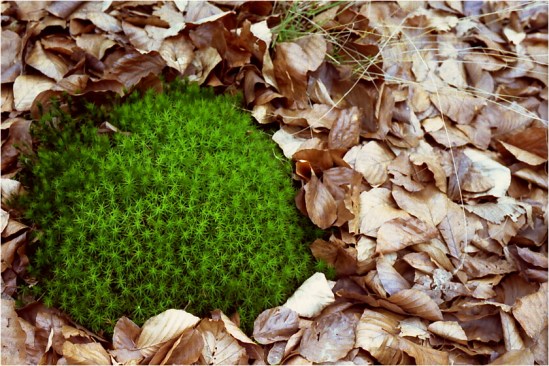
Shelter in a Misty Forest

Winter Leaves

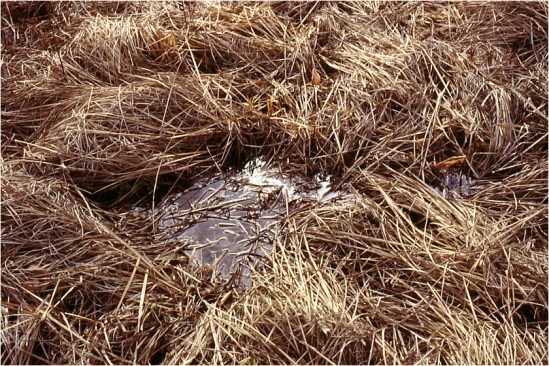
Staring Down at the Sun
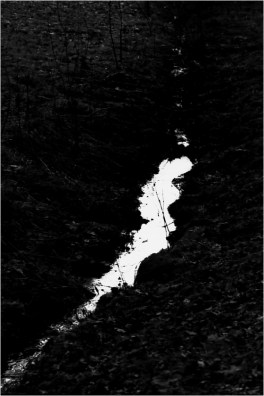
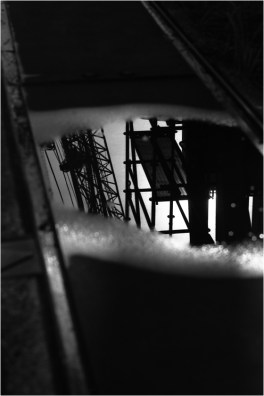
Speed
Daily photos, 365 Photos a year… I can see the appeal of this.* But as for now, I do not travel that fast. Depending on weather, opportunities and interests (or motivation), it can take me two or three weeks to fill a 36-exposure roll of film. Afterwards, I have to allow a couple of days for processing. After receiving the pictures from the lab, I look over the contacts, trying to decide which picture is worth prinitng and what should be scanned and go online. Once I am done with this, I know my pictures quite intimately.

That’s the when I usually get excited about how well I succeeded in making this or that picture. I might hurry to get these exposures scanned and present them to you … or let them lie around untouched for yet another while. Waiting a couple of weeks entails that if I still like a picture after the first rush of euphoria is over – then this picture most likely meets my idea of a good one.
Why do I write this? Speedy publication can be lots of fun. But slowing down can be just as fine: If you are not sure what to think of your picture today, just wait. Time will help you take a step back, consider the picture in a different context and figure out what it means to you.
* There are some great sites for viewing daily pictures: The Window Project 2010 is one of them, and I would also like to mention the daily pictures displayed by Lynn Wiles. And whoever enjoys daily assignments will find them here.
Wood, Vertical

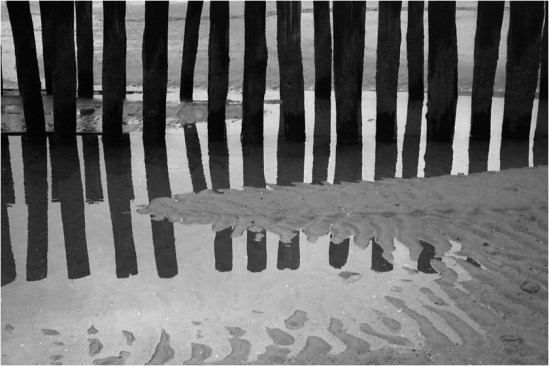
Pocket Landscapes: Shore

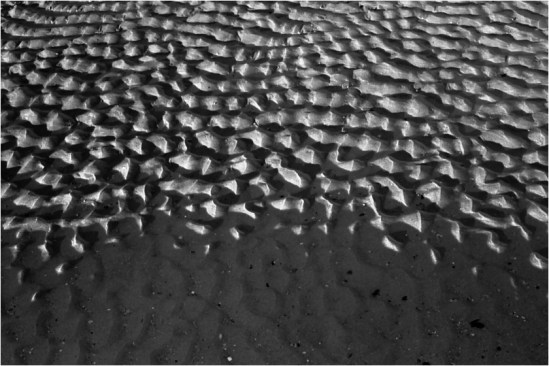
 empire of lights